
Reports and debriefs
You’re not left alone with a report.
Each report shows which topics need attention most. Your debrief helps you frame the conversations that explore them with your people.
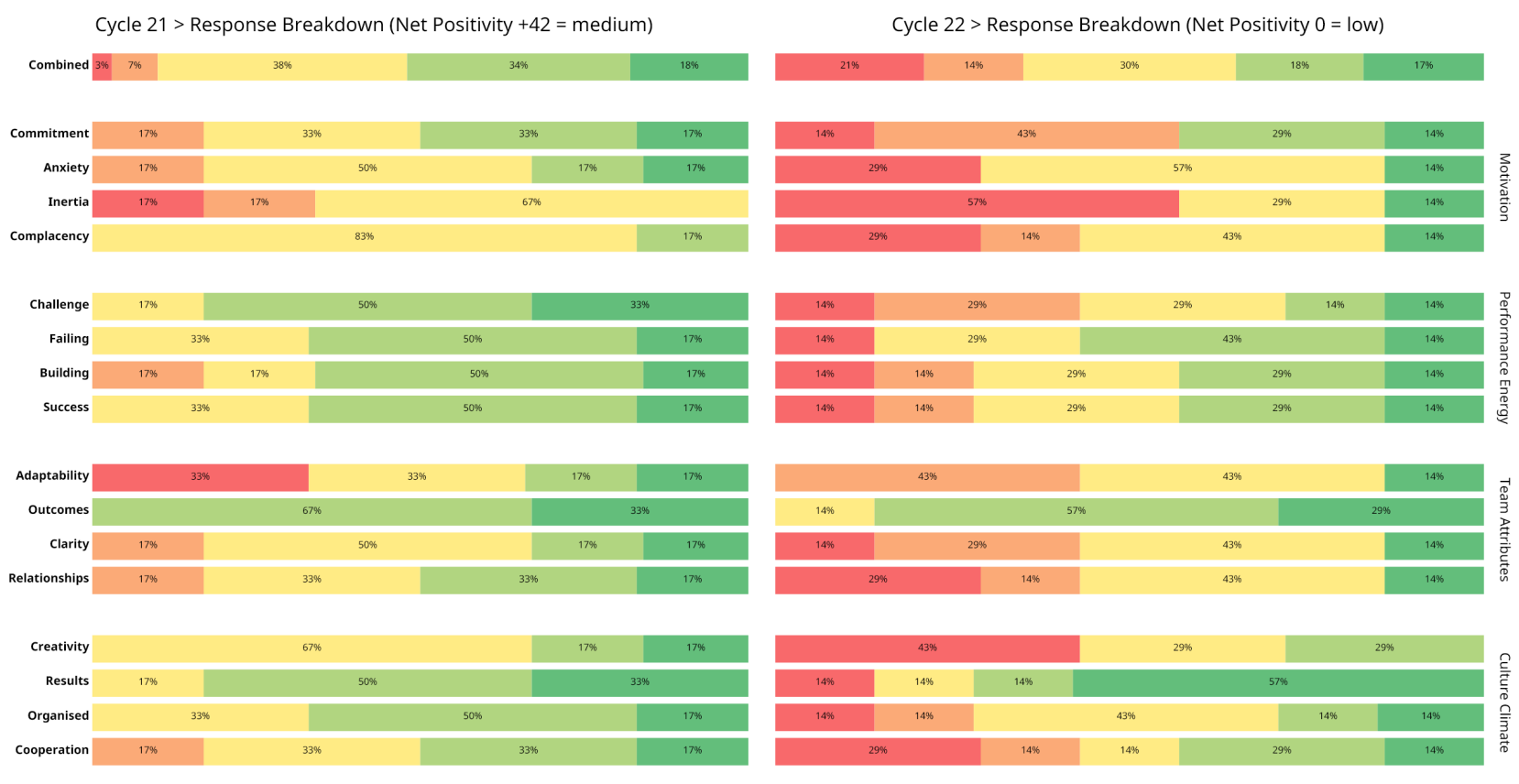
In every report
Clear ratings. Two baselines.
Built to be read by leaders, not data specialists.
Every topic rated
From very high to very low on a five-point, colour-coded scale, and ranked by an overall score.
Two baselines
One drawn from the whole Tensense customer base, and one from your own data, to compare your segments.
Trends over time
A trend line for every topic, tracking how it moves from cycle to cycle.
A minimum for reporting
Segments below the agreed minimum get no report, but still count elsewhere, including the organisation as a whole. Very small segments can swing sharply, so interpret them with care.
How the narrative is written
Each report pairs charts with a written narrative. It’s generated by AI from aggregated data only, never from individual responses, and the charts are the evidence it can be checked against. Before a report goes out, automated rules check the narrative’s structure and tone, and a separate AI review looks for anything misleading, contradictory or overclaimed. Anything doubtful is held for a person to review. Each narrative also sees the previous cycle’s, so it avoids repeating what you already know, but an issue that hasn’t eased stays in view.
Reporting
Three levels of reporting. The whole picture.
Each leader sees the level that matches what they lead, with rapid reporting at the end of each cycle.
- 01
Whole organisation
Local experience across your whole organisation, in one overview.
Typically read by the board or C-suite
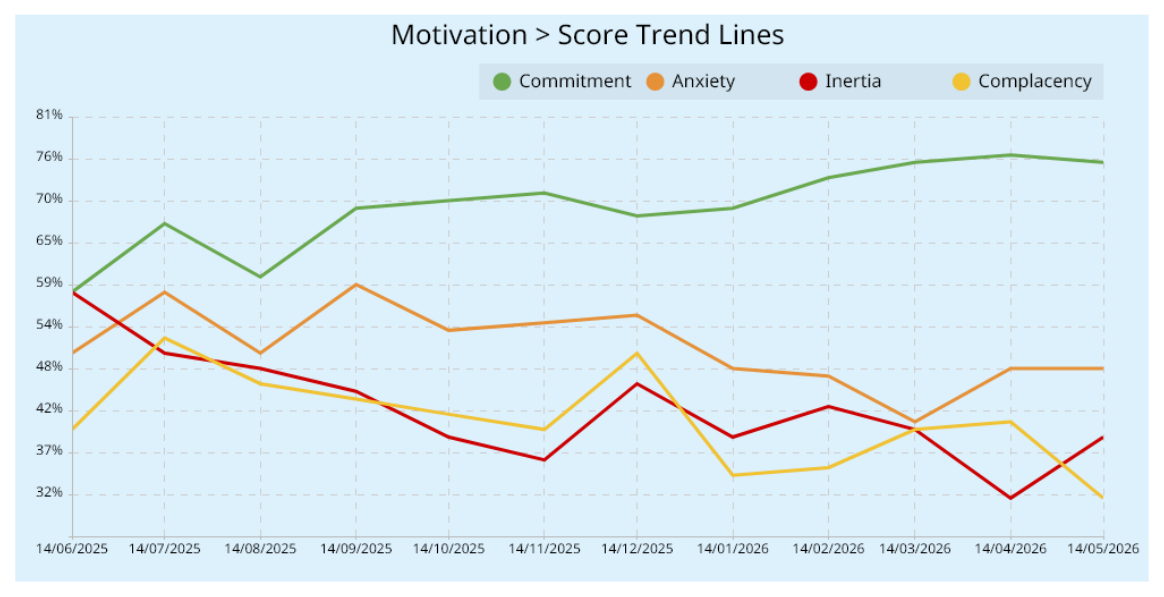
Real Tensense report output · names fictionalised - 02
Segment comparison
Related segments side by side, such as all offices, all teams or all locations.
Typically used by senior leaders

Real Tensense report output · names fictionalised - 03
Single segment
One segment in focus, such as a team, office or department, set against its wider context.
Typically shared with that function’s leader
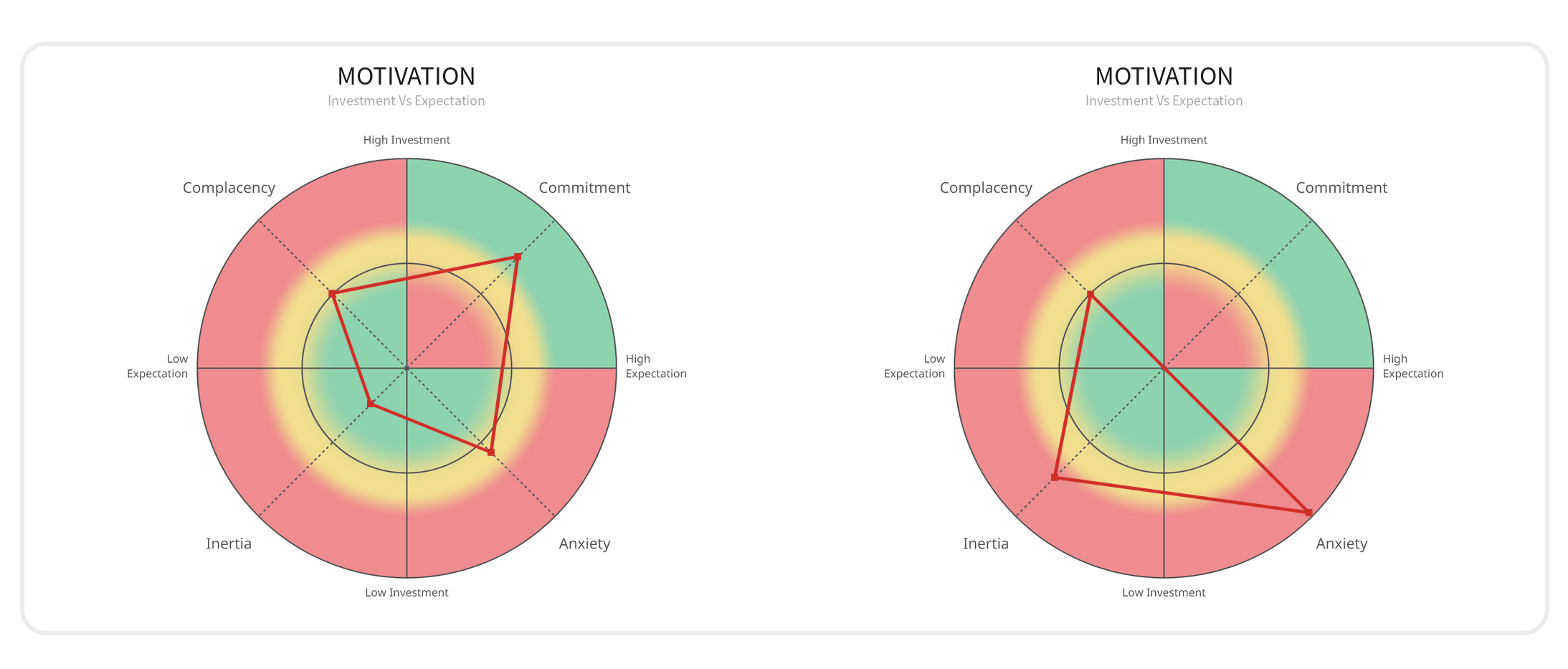
Real Tensense report output · names fictionalised
Segments come from any data you can provide: structural groupings such as an office or team, or attributes such as tenure. The same people can be grouped more than one way, with a separate comparison for each. That is what lets leaders pinpoint where people may need greater support.

Debriefs
A debrief for any leader who wants one.
Virtual debriefs are part of the standard support package. We offer them to any leader in your organisation, individually or as a group.
In a debrief, we help you
- 01
Read the story across topics and lenses.
- 02
Agree which topics to focus on first.
- 03
Plan how to explore them with your team.
Talking with your team
Questions to start with.
Results that confirm what you already know still count: they back a leader’s instinct with evidence. Use them to check whether everyone sees it the same way.
Does this match what you see day to day?
What surprised you, and what didn’t?
What does this prompt mean to each of you?
What would it take to improve in this area?
What’s the story here?
Topics are interpreted individually and together.
Results identify issues, not their causes. People bring their own meaning to each prompt, so the context comes from talking with them.
Performance Energy
ChallengeFailingBuildingSuccessMotivation
CommitmentAnxietyInertiaComplacencyTeam Attributes
AdaptabilityOutcomesClarityRelationshipsCulture Climate
CreativityResultsOrganisedCooperationThese pairings are illustrative, not exhaustive. Which topics connect, and how, comes from analysing your results each cycle, not from fixed rules.
- 01
Interpret together
Look across lenses as well as at each topic. Anxiety alongside Challenge, in any combination of high and low, says more than either alone.
- 02
Form a hypothesis
A hypothesis, not a conclusion: the results show you where to look. Each report sets out leadership priorities to help you decide where to start.
- 03
Explore with your people
Take it to the team with open questions about the group as a whole, not individuals, and ask for examples. Each report suggests reflection questions for leaders and team members.
Then run the next cycle
Act quickly, then check it’s working.
Agree one or two small, testable actions, then run another cycle whenever you need. Each new cycle builds the trend, so you can see whether things are changing, naturally or after you act.
Before each new cycle, ask
What did we explore after the previous cycle, and what did we find?
What could we resolve ourselves, and where can we influence change?
What changed as a result?
What needs senior backing, or a wider initiative, to resolve?
What further support do we need?
Making it work
Play it back. Then act on it.
When people hear nothing back, or see nothing change, they stop responding.
Play back the results
Share what the results show at each level: in town halls and all-hands meetings, and in team meetings. People want to know they’ve been heard, not just listened to.
Show what changed
Playback is a start. People also want to see their concerns acted on: you said, we did. Without either, response rates can fall sharply.
What it takes
Change is hard work.
Tensense does much of the heavy lifting, but making a difference takes effort, buy-in and a willingness to act, as with any survey. It doesn’t work as a vanity project, or if little is done with the reports.
A senior sponsor
Someone senior who champions it, so the results carry weight.
A process owner
Someone with the time, and enough seniority, to coordinate the leaders who receive reports and keep them active and accountable. They’re often not the senior sponsor. The actions belong to those leaders.
Support from HR
To keep names and email addresses current as people join and leave, so invitations reach the right people. Segments need updating too, as people are promoted, managers change, and you find new ways to look at the data, in more or less detail.
Choosing a rhythm
Run it around the work. Not the calendar.
There’s no fixed cadence. Choose the rhythm that suits your organisation and your people, and change it as your needs change. Whichever you choose, every cycle uses the same 16 prompts, so results stay comparable.
Continuous
Cycles run back to back, and leaders act as each set of results arrives, so there’s no gap in what you see.
Paced
A cycle, then a pause to plan and act before the next: for example, three weeks responding, then three weeks acting. It gives a clear moment to act, and feels less relentless.
Milestone
Cycles tied to points in a programme rather than the calendar: a baseline, then stage-gates as people move through the change.
On demand
A cycle whenever there’s a moment worth capturing, with time in between for actions to take effect.
If you run your own annual survey, you can pause Tensense while it’s open, so nobody is asked twice at once.